Now that I’m living in Seattle, I don’t get a chance to visit Southeastern US waterfalls very often, which is why I haven’t posted on this blog in 4 years. But when a friend of mine was asking my recommendation for Georgia waterfalls, it inspired me to do a series of review posts, of which this is the first. My plan is to highlight waterfalls I’ve visited in each region over the years (also mentioning other waterfalls in the process). We’ll start in the Northwest corner of Georgia.

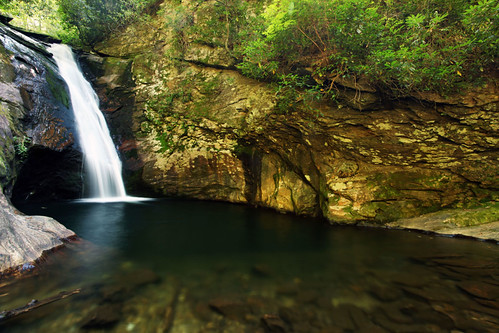
Lookout mountain runs along the extreme northwest corner of the state, reaching from southern Tennessee into Alabama. On that ridge lies one of my favorite Georgia State Parks, Cloundland Canyon. It has beautiful views, but for the sake of this topic, it has a couple of the most beautiful waterfalls in Georgia. On the Waterfall Trail you descend from the mountaintop down 1,200 stairsteps, and the above photo shows the first waterfall you  encounter. For years we’ve called Waterfall #1, though a public vote changed its name to Cherokee Falls. Regardless what you call it, it’s a beautiful 60 ft waterfall, falling into a great rock amphitheater with a splash pool. it is usually best to visit in spring, since in dry summers it often dries up to almost nothing. As you can see in the photo on the right, there are lots of photo composition possibilities around the pool. That photo also shows if you get there in autumn after a rain, it also can be a magical place.
 The next waterfall you encounter at the bottom of the stairs is what used to be known as Waterfall #2, now known as Hemlock Falls. It is a beautiful 90 ft waterfall, also falling into a nice rock amphitheater. Photographically possibilities are more limited because the state park built a very nice viewing platform, not wanting people to injure themselves exploring elsewhere, and that limits access. This is the end of the Waterfalls Trail, but it isn’t the end to waterfalls at Cloudland Canyon. The end of the Waterfalls Trail is the start of the Sitton’s Gulch Trail, which continues down from here along Daniel Creek for another 2 miles.
 Right at the start, it passes by two smaller waterfalls (not officially named by the State Park). Scott and I named them years ago Waterfall #3A & #3B, given they are in quick succession, and not as tall as the first two. The first fall (#3A) is a 20 ft drop, and very photogenic, with composition opportunities all around it.
  The second fall here (#3B) is a small ledge drop of Daniel Creek right after the pool for #3A. But what it lacks in height, it makes up for with composition possibilities from different angles, two photos of which I included here (from different angles and seasons).
 There are also other seasonal waterfalls at Cloudland that you might find; but for now, I’ll leave you with the main falls.
 The next area that I’ll mention is also on Lookout Mountain, in land owned by the Lulu Lake Land Trust. The land is open to the public usually on two Saturdays a month. It has trails
 and the beautiful Lulu Lake (and the small Lulu Lake Falls going into the lake). For today’s discussion though, it also has the very impressive Lula Falls, where Rock Creek pours over 100 ft straight down. This waterfall is similar in style to the main two waterfalls in Cloudland, pouring over the escarpment into a large rock amphitheater. It doesn’t have the pool at the base like the Cloudland falls, but you can walk all around it (and even in the fall), as you can see from the large photo above.
There are also other waterfalls in this far western part of the state, the most famous of which is Keown Falls, managed by the Forest Service. It is extremely low-flow, so I’d recommend it only in spring after a good rain; I haven’t captured a good photo of it. But my blog partner Scott did a blog post here where he captured Keown Falls, Little Keown Falls, and another in the area called Pocket Falls.
A little further to the east still in far north Georgia is the vast and beautiful Cohutta wilderness of the Chattahoochee-Oconee National Forest.  The area has 90 miles of trails deep into wilderness, on many of which you will encounter few people the entire day (one day I saw more wild boars than people). There are also many waterfalls in the Cohutta, but most of them I haven’t been able to visit. The most famous waterfall in the Cohutta is the 80 ft powerful Jacks River Falls. The classic hike to get to Jacks River Falls is epic, requiring an 18 mile (round trip) hike with 20 river crossings. I still would like to try that sometime, but I have not yet.
But there are other waterfalls in the Cohutta I have visited. One roadside fall is the 15 feet Barnes Creek Falls, part of which is shown on the right. The Forest Service has a picnic area by the waterfall, and it’s worth stopping when in the area.
Both times I have stopped by Barnes Creek has been on my way to other waterfalls in the Cohutta, hiking to Panther Creek Falls. Panther Creek is tough to access, with two options requiring either a long hike with a ridiculously steep drop to get to the top of the  fall (the direction we went) or many waist-deep stream crossings. The day we went there was dense fog, and it was so beautiful that the grueling hike was worth the effort. Panther Creek Falls itself is a huge 400 ft tall waterfall. But it’s difficult to get a view of it all since it’s deep in wilderness with no viewing platform–and the day we were there it was too foggy to see all of the fall. So I contented myself with photos of sections of it, as in the photos to the left and below. Here’s a link to a photo by Mark Morrison that shows the main drop. There are also many other falls in the Cohutta, and most hiking books have descriptions how to get there. And hiking in the Cohutta is a worthy adventure in its own right.

So there you have 3 places in northwest Georgia (and a 4th if there’s a lot of rain) that are great locations to explore waterfalls. Once spring starts soon, I expect you all who now live nearby to get out and explore some waterfalls!


 Moccasin Creek, near Lake Burton and before the creek flows through
 I knew I was losing time, and it required bushwhacking to get to it, so I passed it up this time for greener pastures. That didn’t take very long, since in another 0.1 mi, the next drop occurred, a 10 ft two-step drop that is right before a bridge on the trail crossing to the other side of the creek. Like the first fall, it only required a minimal off-trail scramble to get to it, but I’d only recommend it if you don’t mind risking getting dirty in the mud.


 The Tallulah Gorge was one of north Georgia’s first tourist attractions, one of many areas that over the years have been dubbed the “Niagara of the South.” It’s a gorge created by the Tallulah River, which is over 800 ft at its deepest. It first became popular in the late 1800s due to railway being built to it, and was extremely popular until dams were built upriver of it in the 1910s. The completion of the dam in 1913 dramatically cut the water flow, and the tourists disappeared–until it became a
  You can manage to see most of them from viewpoints around the gorge, but the best way to see them is to descend into the gorge. As you do so, the first you encounter is the first fall in the series, 46 ft tall L’Eau d’Or Falls. As you can see, this day it was wonderfully foggy, which I think was great for the waterfall shots. This view is from an easily accessed viewing platform, which you will likely not have to yourself (unless it’s early in the morning on a foggy day). 🙂 It also is a great place to see with

 My final goal for the day was to capture a photo of the Caledonia Cascade. It is a 600 ft waterfall, which pours from a feeder stream down the side of the gorge. It’s a low-flow waterfall, as you can see in the photo I took from across the gorge, even in spring, and often is almost non-existent later in the year. Much of it can’t be seen from the other side due to tree cover, and as such, this photo only represents around 1/4 of the full height of the fall. It’s funny–sometimes books or websites obsess over which waterfalls are the “tallest,” implying that’s automatically the best. I think this is a good example of how it’s not always the case; though this is one of the tallest waterfalls in Georgia, it certainly isn’t one of the “best,” at least in my opinion. Even though the cascade wasn’t impressive, the Tallulah Gorge was, and the weather on Saturday was great for photography and waterfalling.
  Crow Mountain Creek Falls (we passed by
 We used a higher-clearance vehicle to cross Crow Mountain Creek, and drove to the end of the road at the entrance to Blood Mountain Wilderness. Then it’s a easily-followed trail for 1 mile (the last 1/2 of which along Blood Mountain Creek) to the upper falls. At the base of the upper falls was this beautiful little cascade into a nice pool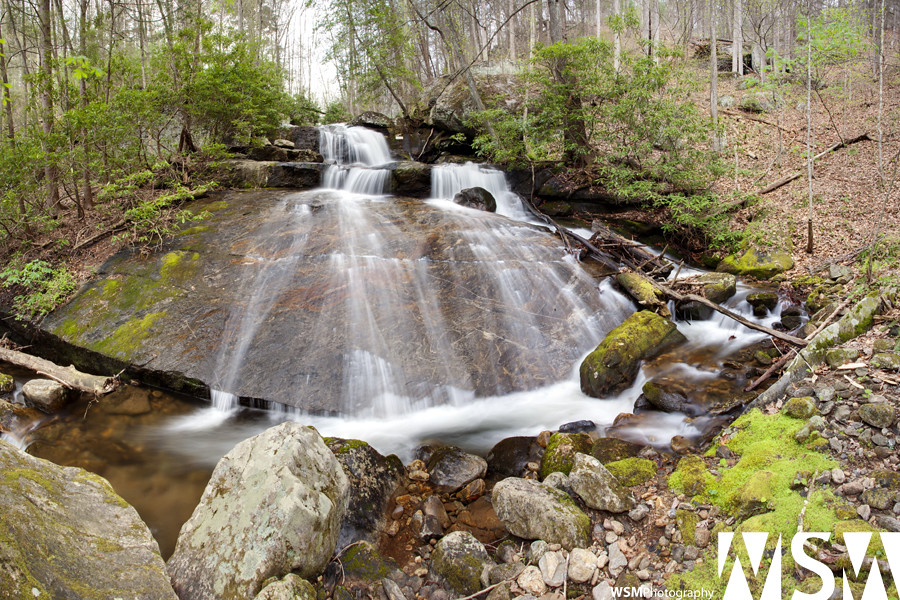
 this day, which was a “bonus fall” that we didn’t know before existed, Upper Dick’s Creek Falls. We saw it right beside the road to Upper Blood Mountain Creek, but visited it on the way back, especially since there were fishermen there the first time. We stopped by and visited this nice little 20 ft fall as the finale for the day. It was not an amazing fall, but required no effort to get to, and still has the wonderful brown creekbed color I love in north Georgia. Visiting 3 waterfalls that I hadn’t seen before made this definitely a successful day!


 This fall was really impressive, and more dramatic than we expected it to be, being more than 30 ft series of steps. It also had really beautiful rock colors. However, the sun really did a number on any photo that was taken of it, providing way too much contrast. Again, I think that with spring greenery, flow, and even lighting, this could produce a really amazing waterfall shot. We’ll just have to come back later in the spring to try…


 and climbed up 44 old (and mossy) stone steps. There, we came to a previously planned railroad bed;
  Horsepasture River on our way up to the Blue Ridge. The Horsepasture is an amazing wild river (which undoubtedly deserves its own post in the future) with multiple waterfalls, but this time we only visited Rainbow Falls. Rainbow is one of my favorite NC waterfalls, with its amazing wild setting, being able to access it, and being a powerful 125 ft waterfall. Also the first time I visited it was in
  The next morning we started off on the Blue Ridge Parkway, and the fall we visited was one I’ve wanted to see for a while, Crabtree Falls. It’s a popular stop on the Blue Ridge, with its own recreation and camping area. As




 Doug
Doug wizum
wizum


